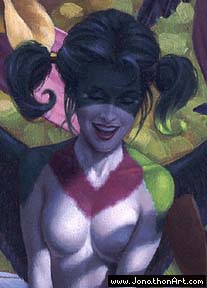
 I have a long and delightful relationship with Thalia, the Muse of Comedy. She lets me know when she has something to say, and I write it down for her.
—
There are those who would say that Thalia Herself is a figure of fantasy. There are differences between Myths, Archetypes, folklore and fantasy, but we won’t go into them here — mostly because I tend to cross the lines all over the place, myself. You may regard me as Fantasy if you wish, dear — just keep writing.
What Is Fantasy?
 On any mailing list, that question is good for about a week’s worth of debate. Which will eventually end without ever coming to a conclusion. In general, “fantasy” is fiction in which things can exist and happen that would not normally exist and happen in our waking lives. Unlike science fiction, it is permissible in fantasy to violate physical laws as we know them, even to flout logic itself — although most modern readers favor stories in which the fantasy elements are consistent within themselves; if you are going to have magic, have it follow its own logical system.
What is the difference between teleporting by magic mirror, teleporting by human mental power discovered in a scientific laboratory, Scotty beaming up you up with the transporter, or traveling long distances instantly through hyperspace? It’s all “babble a little and pretend that explains it.”
The first one is fantasy because while waving your hands and babbling you used the word “magic.” The others are all science fiction because while waving your hands and babbling you used the word “science.”
 Anitra likes to say that science fiction is an excellent way to ask “What is ‘being human’?” and fantasy is an excellent way to ask “What is reality?” To me, the most powerful fantasy embodies archetypes, like folklore and mythology do and classic literature often does. It is easiest to deal with archetypes, dream images, and many other fundamentals of human psychology in fantasy, which echoes the earliest stories of our childhood and the human race’s childhood.
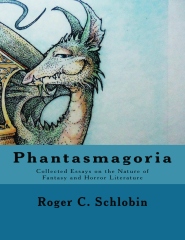
If you do want to analyze it some more, I recommend Phantasmagoria, a set of excellent essays by Roger Schlobin.
Ultimately, I define fantasy by reference to stories that I consider fantasy.
The Forgotten Beasts of Eld, by Patricia McKillip, is a classic example of high fantasy. “High fantasy” is what most people think of in reference to “fantasy”: stories dealing with wizards, elves & magical beasts, uually in a low-technology, medievalish setting.
The Little Country, by Charles de Lint, is another classic. This is an example of “urban fantasy”, by one of the pillars of the genre. “High fantasy” tends to take place “long ago and far away”, usually in a low-technology setting. In urban fantasy, the setting is updated to our own modern world, yet the elements of magic and myth and archetype are kept. It takes a great deal of talent to make this work without making it a comic parody, but de Lint has the talent.
The Empire of the East, by Fred Saberhagen, is harder to classify. One review (by Eric S. Raymond) says, “Is this post-holocaust technology-of-magic SF, or heroic fantasy with rivets for flavor?” You’ve got gods, heroes, magic, a coming-of-age quest, and a whopping big army tank — you want to quibble about categories? As Eric says, “…it’s powerful stuff, a grabber from page one. Enjoy!”
 Mojo and the Pickle Jar by Douglas Bell is another example of urban fantasy — and comic fantasy. It’s an example of a lot of things, all mixed together. It won the Philip K. Dick Award in 1991. It’s out of print, but look for it — it’s worth the effort.
I don’t think you need a definition of comic fantasy, do you? If you do, pick up any Discworld book by Terry Pratchett. You’ll get the definition.
Some Fantasy Links
Charles de Lint homepage
Master of Urban Fantasy
The L-Space Web for all things Terry Pratchett & Discworldly
Jane Yolen a bibliography on Inkspot
Mistress of Fables
Patricia McKillip a bibliography from Putnam Berkeley Online
Patricia McKillip a fan page
Mistress of High Fantasy.
IF YOU LIKE THIS, THEN YOU’LL LIKE THAT page of the Ultimate Science Fiction Web Guide from MagicDragon Multimedia
Remember: Save America’s Vanishing Frompers!
Images adapted from the art of Jonathon Bowser and Brian Froud by Fantasyland Graphics


